
Searching Reno County Civil Dockets
Reno County District Court civil cases start at the Kansas District Court Public Access Portal. A case number is the fastest route in. Party and business names also work. Filters for county, filing date, case type, status, and judicial officer then narrow similar matches. Choose the Reno County location instead of trusting a broad statewide name match.
The portal is not the only channel. Some converted public documents appear only at the first-floor courthouse terminal. Amanda Flores, Chief Clerk of District Court, handles written requests and mail. Her office also takes counter visits, phone questions, copies, and certifications. Note that Kansas eFiling serves authorized filers, not public docket lookup.
- Open the Kansas portal and choose Reno County in the location filter.
- Enter the complete case number, party name, or business name.
- Narrow the list by civil case type, date, status, or judge.
- Open the correct result and review Case History and document notices.
- Use the terminal or clerk request route for an eligible file not shown online.
Reno County Civil Docket Divisions
Local Rule 5 divides Reno County civil dockets among the judges. Chapter 60 cases split by number. Odd-numbered files land in Division I; even-numbered files in Division II. Division IV takes Chapters 61, 59, and 38. Small claims under the cited Kansas procedure, along with PFA and PFS matters, go to Position I. Ex parte requests go to the assigned judge, who has substitute authority when needed.
| Case route | Reno assignment | Practical search point |
|---|---|---|
| Chapter 60, odd number | Division I | Check number and current judge |
| Chapter 60, even number | Division II | Check number and current judge |
| Chapters 61, 59, 38 | Division IV | Confirm displayed case type |
| Small claims, PFA, PFS | Position I | Use portal and clerk record |
Treat the assignment map as a starting point. The current docket still governs. A substitution, conflict, or later authorized change can shift the judicial officer on a live case.
Inside a Reno County Civil Docket
A Reno County civil docket pairs basic case fields with a chronological register of action. The public view may include the case number, filing date, county location, civil or domestic type, judge, status, party roles, counsel, event dates, hearing settings, outcome fields, and document links or unavailable notices. It does not reveal every fact alleged in a pleading.
| Case number and filed date | Identify the file and when the court accepted it. |
|---|---|
| Parties and roles | Identify public plaintiff, defendant, petitioner, respondent, or other roles. |
| Case History | Lists dated events, filings, settings, orders, judgments, and administrative entries. |
| Judicial officer and status | Show current assignment and the portal's open, closed, pending, or disposed category. |
| Document availability | Shows whether an eligible pleading or order can be viewed remotely. |
An entry is not the underlying file. The register may show an entered order while the signed order stays unavailable online. When wording or legal effect matters, the clerk's official copy controls.
Reno County Civil Docket Counts
Official Kansas reports sort civil filings into regular actions, limited actions, and domestic relations for periods ending June 30. For 2024, Reno County reported 330 regular actions and 2,603 limited actions, with an all-category total of 3,692. The 2023 row showed 351 regular actions and 1,867 limited actions, totaling 3,024.
The 2024 regular-action count has four parts. It breaks down as 51 contract, 128 other, 89 real-property, and 62 tort filings. Limited-action contract filings numbered 2,587. That category jumped from 1,821 in 2023, a large reported rise. The source names no cause. So the figures say nothing about local events and cannot predict an individual case.
Civil Case Types on the Docket
Reno County District Court has broad civil jurisdiction, yet "civil" is not one track. Case type drives division assignment, forms, procedure, and remote document access. Trust the portal's displayed label over guesses from a party name or a brief event.
- Regular Chapter 60 matters, including contract, tort, property, and other damage suits.
- Limited actions and small claims, which follow distinct Kansas procedures.
- Domestic relations, including marital status, parentage, and related support matters.
- Protection from abuse and protection from stalking proceedings.
- Probate, estate administration, guardianship, and conservatorship matters.
- Juvenile and child-in-need-of-care matters with special confidentiality rules.
PFA stands for protection from abuse; PFS for protection from stalking. Chapter 59 generally supplies the probate context. Chapter 61 covers limited-action and small-claims routes. These labels mark a path through Reno County civil dockets. They do not promise that every document is open online.
Reno County Civil History Versus File
Case History is the portal's presentation of docket activity. It can show a petition, answer, summons, motion, notice, scheduling conference, mediation, pretrial event, judgment, dismissal, journal entry, appeal, or enforcement step being recorded. The civil file itself holds the documents behind those entries when public and retained.
| Question | Case History | Filed document |
|---|---|---|
| Was an event recorded? | Usually the best first check | May confirm more detail |
| What exact language controls? | Brief description only | Read the signed order |
| Is it always downloadable? | History may be visible | Remote access may be limited |
When an event is visible but its attachment is not, check the courthouse terminal. Or ask the clerk whether the document is public, converted, archived, or restricted. An unavailable link is not proof that nothing was filed.
Civil Docket Settings and Hearings
A setting is a scheduled court event, not a result. Reno County civil dockets may record scheduling conferences, motion hearings, mediation, pretrial hearings, trial dates, or enforcement proceedings. One scheduling order can set several deadlines and appearances. A continuance or later order may move them.
Verify the date, time, courtroom or division, judicial officer, and setting type against the latest Case History. If sources conflict, call the clerk. Amanda Flores's office is at 620-694-2956. The courthouse sits at 206 W 1st Avenue, Hutchinson, KS 67501. For more on settings, see the Reno County court dates resource.
Missing Reno County Civil Documents
The Kansas portal and the courthouse kiosk are two different windows into the same civil docket. Some converted public documents show up on the terminal inside the courthouse. Yet they never reach the website. Reno's online coverage starts in April 2003. The public computer at the courthouse goes back further, to January 1992, though neither cutoff promises that every older filing was ever digitized.
Next step: Note the Reno County civil docket number, event date, and exact filing. Ask whether the document is public, terminal-only, archived, or subject to a written request.
For record requests, Reno County lists its fees plainly. Request work runs $18.57 per hour. Copies cost $0.25 per page. Certification adds $1, and files pulled from the storage vault carry a $35 charge. Ask the clerk to confirm those amounts and to give an estimate before a large or older order proceeds. A written request should spell out enough detail, such as parties and dates. That is what lets the clerk actually locate the file.
Civil Docket Access Rules
A civil register can be open to the public. Its documents may stay sealed from remote view or from view entirely. Kansas Rule 22 places restrictions on domestic, child-custody, support, child-welfare, juvenile, adoption, guardianship, and similar sensitive case records. K.S.A. 38-2211 covers child-in-need-of-care files on its own terms. Sealing and redaction work through a good-cause process under K.S.A. 60-2617. The official Kansas sealing and redaction statute spells out that good-cause procedure in full.
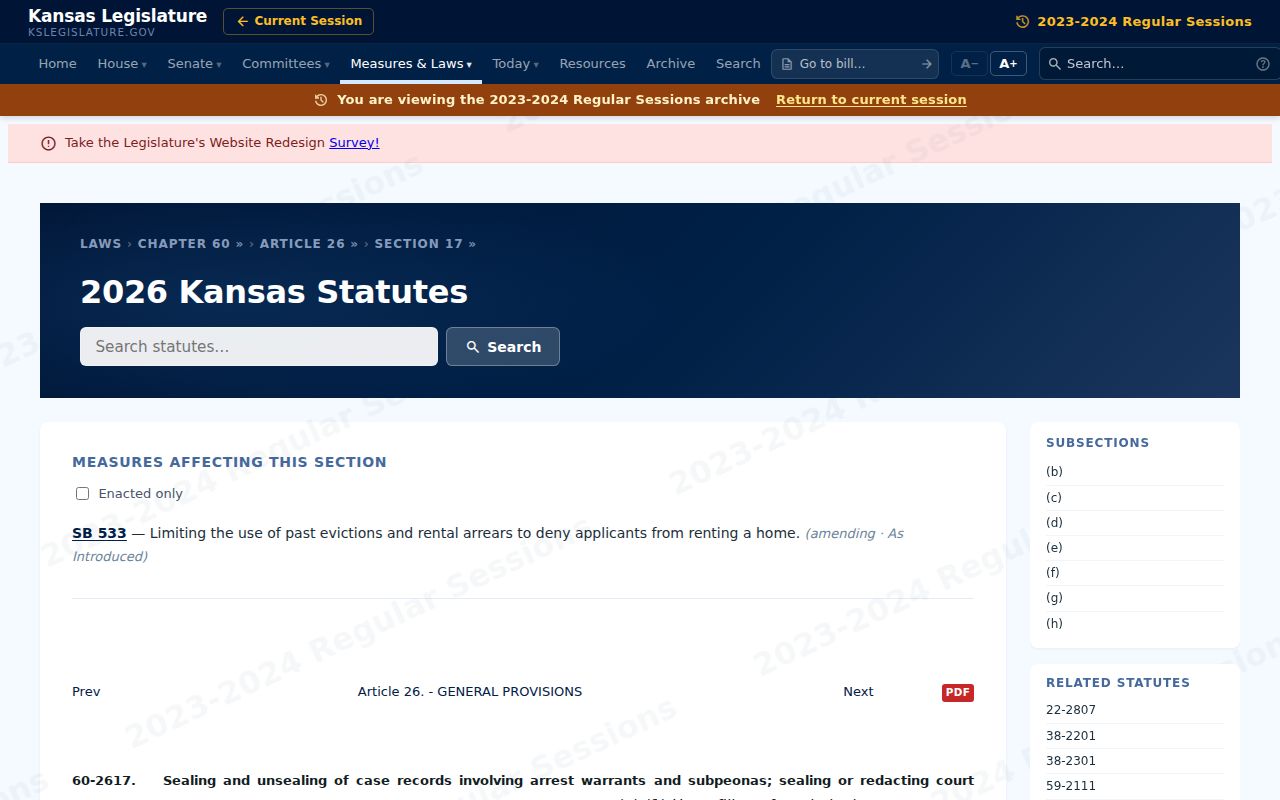
The statute makes one point clear. Access to a civil docket entry turns on the governing rule or court order, not on whether the portal happens to display the event.
Key rules:
Kansas Supreme Court Rule 22 separates public portal and courthouse-terminal access.
K.S.A. 38-2211 limits access to CINC official and social files.
K.S.A. 45-218 addresses inspection facilities and agency response.
Reno County Civil Docket Channels
A complete Reno County civil docket search means picking the right channel for the job. The Kansas portal is quickest for public case information. The first-floor courthouse terminal can hold public converted material that never appears remotely. For copies and file questions, use the clerk's counter, phone, mail, or a written record request. Remember that certification comes only from the clerk, never from a portal printout. Kansas law directs that a records request be acted on as soon as possible. The deadline is the end of the third business day. That response may simply explain a delay rather than deliver a large file. If denied, you can ask in writing for the denial and its legal ground. These rules never override a court seal or a special confidentiality statute. Name a specific document and date range. Ask for an itemized cost statement when the estimate runs high.
Narrowing Reno County Civil Name Results
A common name can pull up a long list of Kansas civil cases. So can a business name. Keep Reno County selected while you sort. Compare case type, filed date, status, and judicial officer across the results. Party role matters too. The same name can be a plaintiff in one record and a defendant or respondent in another. When the case number, filing period, or a court notice can anchor the match, trust that over the name alone. Once a likely case appears, check its Case History against the event or hearing you are researching. A similar name and an open status prove nothing. If doubt lingers, hand the clerk the candidate case numbers and the known filing date instead of copying details from the wrong court record.