
Getting Reno County Court Records
The official file lives with the Reno County District Court, which sits in Kansas's 27th Judicial District. For a case number, a party listing, or an event history, try the Kansas District Court Public Access Portal first. Select Reno County as the location. Keep its limits in mind. The portal is a convenience, not the official record, and its document view is narrower than what the courthouse provides.
There are other routes. A public terminal on the courthouse's first floor sits behind security and runs from 8:00 a.m. to 4:00 p.m. on weekdays other than holidays. Mail requests go to Clerk of the District Court, Attn: Records, 206 W 1st Avenue, Hutchinson, KS 67501. Enclose a self-addressed stamped envelope. If a file might be restricted, stored in the vault, or missing from the web, call 620-694-2956 before making the trip.
- Use the portal or clerk to identify the Reno County case number.
- Name the document, event history, order, or date range needed.
- Choose the web portal, courthouse terminal, clerk counter, phone, or mailed request channel.
- Ask whether a plain or certified Reno County court record fits the need.
- Confirm the current fee, delivery method, and any advance payment before submission.
Reno County Record Request Details
Do not treat a record request as a name-search form. The Reno County Records page requires a case number on every request. Working from a party name alone? Run the statewide search first, or ask the clerk which option fits. A solid request names the court and county. It points to the specific document or register of action, gives the relevant date, states whether certification is wanted, and picks delivery or pickup.
The county's court forms and filing page lays out the clerk's broader workflow. That includes the local forms route and filing channels.
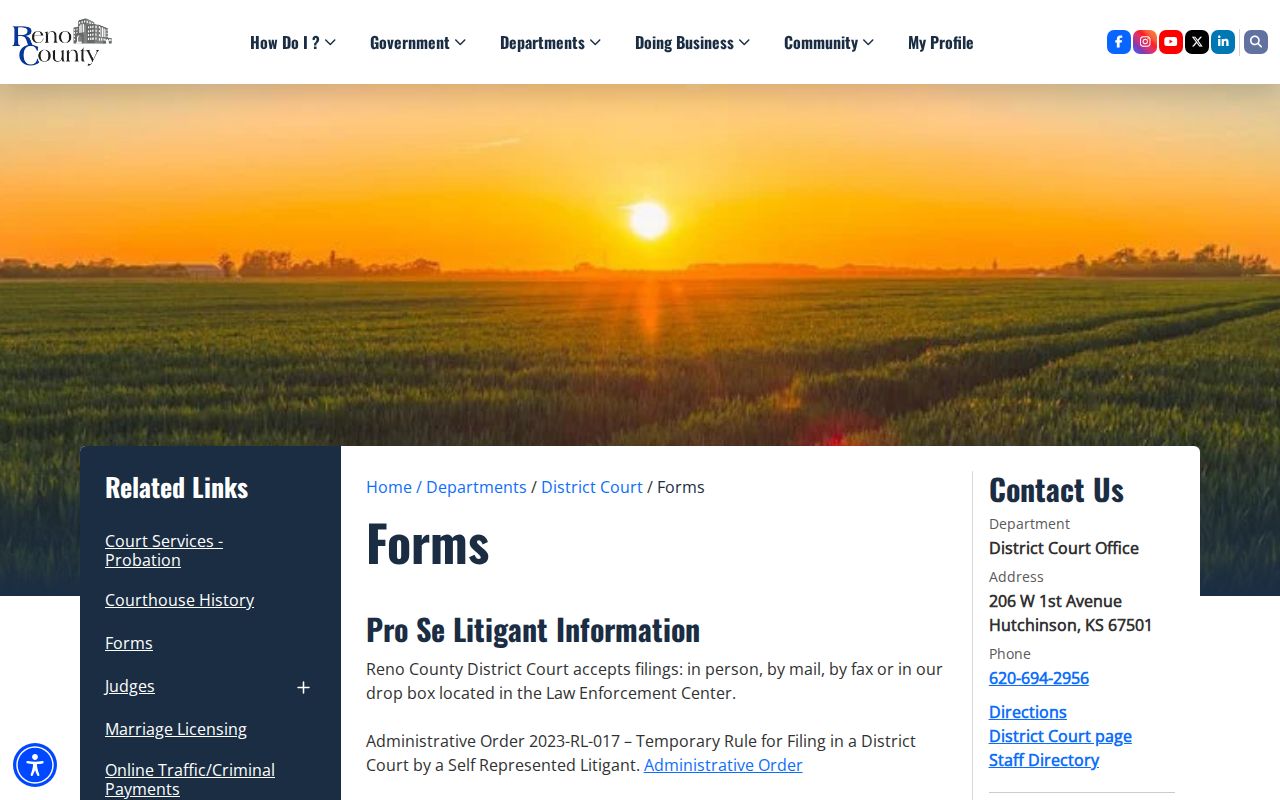
That page draws a useful line. Filing pushes a new paper into a case; a records request asks the clerk for an existing Reno County court record. Kansas eFiling serves authorized filers only, and it is not a public search portal.
Court Record Types
The docket, or Case History, is the chronological index. Behind it sits the case file, which holds the actual documents. Depending on the case type and the access rules, a Reno County court record may include a petition or charging instrument, an answer, service returns, motions, briefs, notices, affidavits, scheduling papers, orders, judgments, dispositions, and post-judgment entries. Exhibits and transcripts may exist too. They are not always public or reachable from home.
- Case information, including number, type, parties, judge, and hearing dates
- Register of action or Case History entries recording events in time order
- Filed pleadings, motions, notices, and service records when accessible
- Journal entries, signed orders, judgments, and recorded dispositions
- Certified copies authenticated by the Reno County District Court clerk
One caution belongs here. A docket line you can see does not guarantee the linked document will open on the web. And an online status label never substitutes for the signed order that carries the exact ruling.
Four Reno County Access Layers
Each channel answers a different question. The public portal gives remote case information. It also serves eligible newer documents. The courthouse kiosk can display public material left out of remote access. That includes public converted documents. A clerk request gets you a chosen copy or a certification. The District Attorney's weekly criminal PDF is only a scheduling aid, never the complete file.
| Channel | Best Use | Limit |
|---|---|---|
| Kansas public portal | Remote case and event search | Not every public document is online |
| Courthouse terminal | Public Reno County records, including eligible converted items | In-person access behind security |
| Clerk request | Named document, plain copy, or certification | Case number and fees may be required |
| DA weekly docket | Criminal setting overview | Calendar only, not the official case file |
Need the full filing history? The county case lookup can find the number first, before a focused document request goes to the clerk.
Inside a Reno County Court Record
Every field has a narrow job. Kansas Supreme Court Rule 106B supplies the label. It names the chronological activity list a register of action. The portal labels its event display Case History. Neither term promises that every document, allegation, or fact appears there. When the precise language matters, read the signed filing or order itself.
| Case Number | A unique identifier, often using a county, year, case-type, and sequence format. |
|---|---|
| Filed Date | The date the case was opened or accepted, not necessarily the event date. |
| Case History | Recorded filings, settings, orders, and administrative events in time order. |
| Judicial Officer | The assigned judge or magistrate, which may change under local rules. |
| Status | The system's open, closed, pending, or disposed label; history explains the change. |
| Document | A filed or issued record behind an entry, if public and available through that channel. |
Read the labels with care. "Filed" does not mean proved, and "scheduled" does not mean held. A Reno County court record is best read as a set of dated court acts rather than a short story of the dispute.
Older Reno County Court Records
Different channels start at different points. The county says online records begin in April 2003, while the public courthouse computer reaches back to January 1992. Those dates are not interchangeable. Kansas's Smart Search update adds that documents converted from the system used before Odyssey are not on the public web portal, though public converted documents may be viewed at a courthouse kiosk.
A blank web result proves nothing. An older record, a conversion limit, a search mismatch, or a legal restriction can each hide a file that exists, so check the terminal or ask the clerk about storage. Historic storage can also add retrieval work and cost.
Reno County's inspection framework rests on the official K.S.A. 45-218 source.
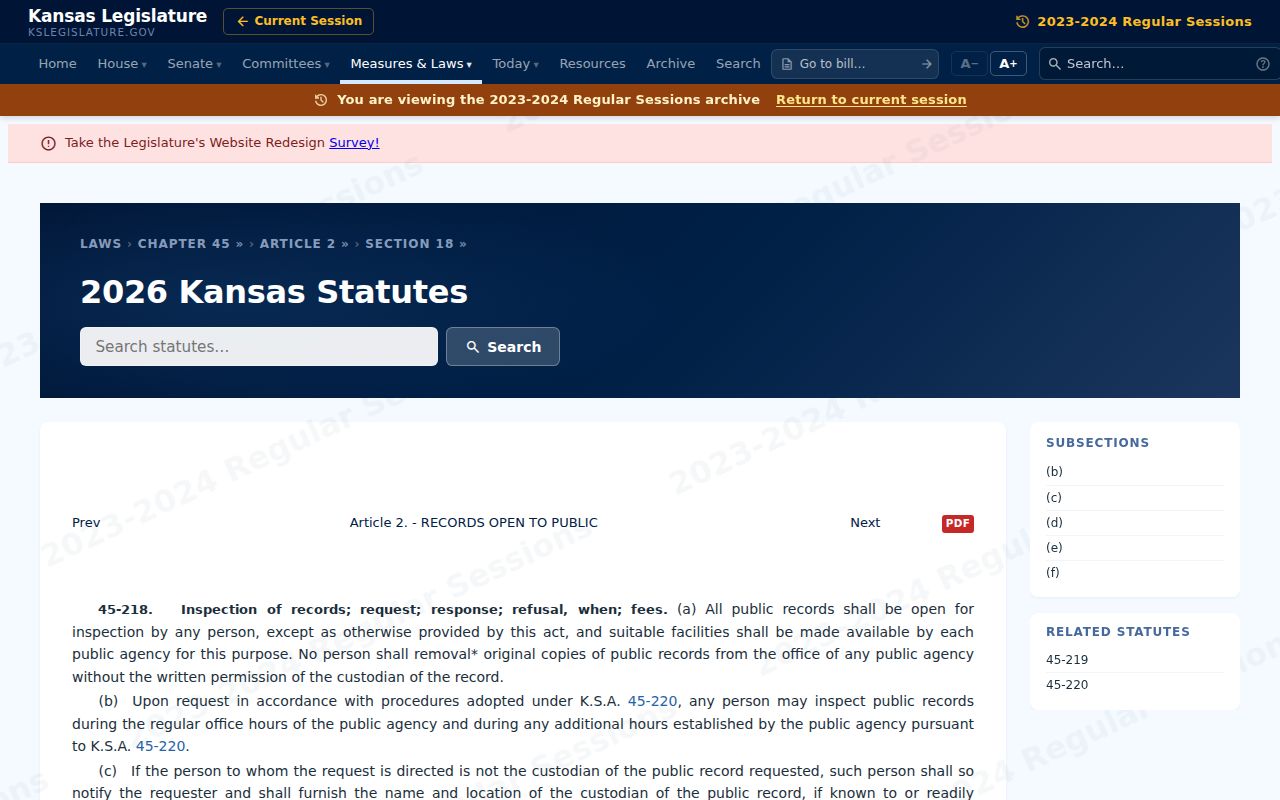
That statute backs suitable inspection facilities and prompt handling. Court rules still decide which judicial records and documents may be released.
Fees and Certified Copies
A plain copy just reproduces an accessible record. A certified copy carries the clerk's authentication. When you need exact order language, proof of entry, a certified disposition, or formal proof of status, use the clerk-issued version. The portal's screen and a payment receipt are not certified Reno County court records.
| Item | Posted Amount |
|---|---|
| Request work | $18.57 per hour |
| Paper copy | $0.25 per page |
| Certification | $1 per certification |
| Underground vault or storage retrieval | $35 |
The county publishes these figures as its current schedule, so treat them as what you will pay today rather than a quote for later. K.S.A. 45-219 governs the charges, covering copy fees, access fees, actual cost, and itemized billing.
Ask for an estimate first if your request is large, old, or certified. Payment up front may be required, and the clerk can tell you whether the format you pick carries its own fee.
Reno County District Court Clerk
Attn: Records, 206 W 1st Avenue
Hutchinson, KS 67501
620-694-2956
When Reno County Screens Fall Short
The public portal itself warns that its information is not the official record. Keep that in mind when you see a Reno County docket entry but cannot open the order behind it, when an older converted document is missing, or when a system status line leaves you guessing. Don't guess. Instead, request the exact order, journal entry, disposition, or register from Amanda Flores, Chief Clerk of District Court. The courthouse terminal works for public material too.
Reno County court records also live apart from city, federal, and public-safety files. Municipal clerks hold city-ordinance cases. Federal matters run through PACER and the federal clerk. Booking and corrections records belong to public-safety systems. Know which court created the file. Your request then goes to the right office the first time.
Sealed Records and Public Access
Public access and remote download are two different things in Reno County. The rules draw a line. Anyone can pull some things up from home. Other items show only on a courthouse terminal. Kansas Supreme Court Rule 22 sets up that two-tier system. It also shields whole categories from online view. Domestic-relations filings, child matters, adoption records, and certain traffic citations stay off the public portal. They may still sit in the court docket at the courthouse. Juvenile and child-in-need-of-care files face added limits under Kansas law.
The state legislature drew its own line, too. K.S.A. 45-221 spells out which public records Kansas keeps closed.
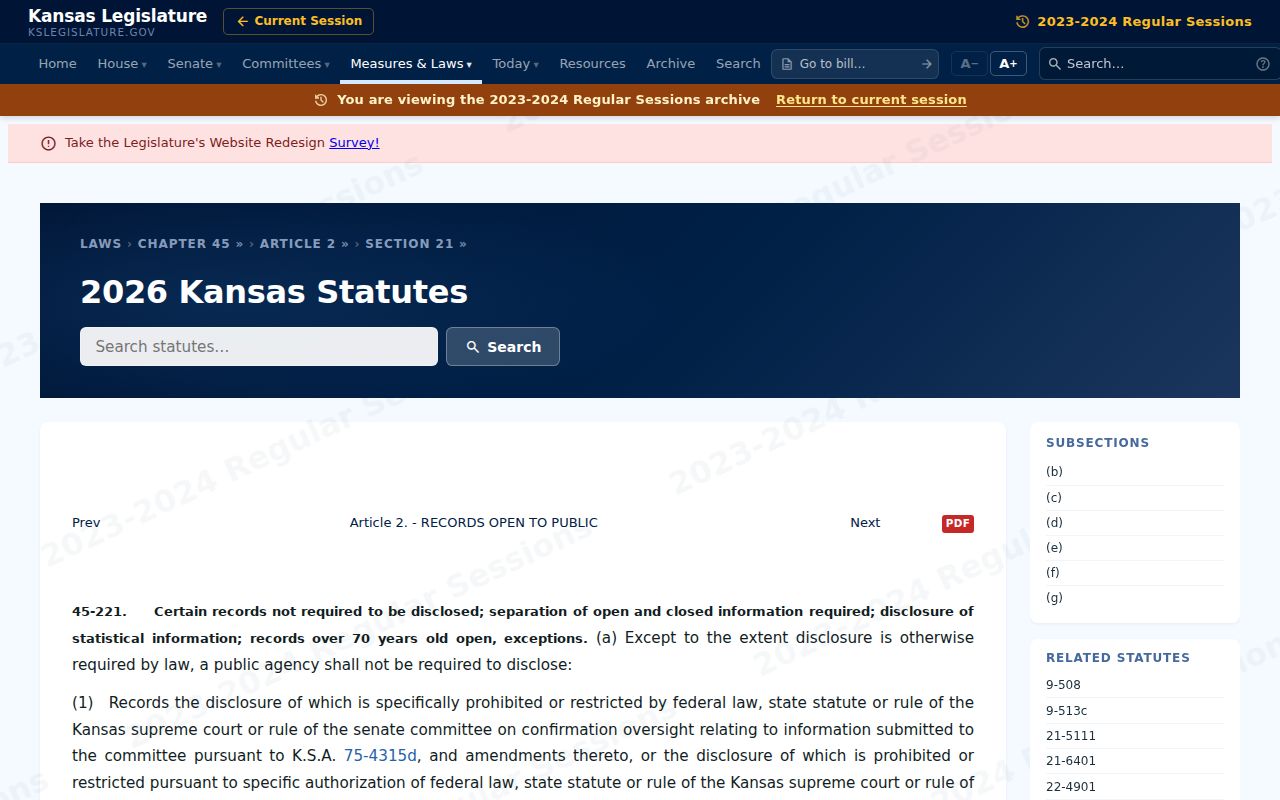
The exemption source explains why redaction or withholding can be lawful. It cannot turn a general records request into a way around a court order.
Key access rules:
Supreme Court Rule 106B defines electronic access and the register of action.
K.S.A. 60-2617 governs sealing, redaction, and closed proceedings after the required findings.
K.S.A. 38-2211 limits access to child-in-need-of-care official and social files.
Reno County Request Response Rules
Under K.S.A. 45-218, the office should act on a request as soon as possible. The outer limit is the end of the third business day after receipt. That clock covers the response, not the delivery of every file. If access is delayed, the custodian should say why. The office must also give the earliest place, date, and time of availability. You may also request a written statement of the legal grounds for any denial.
For Reno County court records, judicial rules and sealing orders still control. Ask whether public material can be separated out and released with protected details redacted. Keep the request narrow. Hold on to the fee estimate. Confirm the current county page before relying on any posted amount or access hour.
Note: A sealed file stays sealed unless the court changes the order. A Kansas Open Records Act request does not unlock it.